
In Germany, large protests have called for banning the far-right Alternative for Germany (AfD-ESN) party. Amidst the public discussion, a question must be asked: Can the ‘strongest democracy in Europe’ really ban its largest opposition party?
Trigger point: AfD categorisation as ‘definitely right-wing extremist’ by the German domestic secret service
Following the Nazi dictatorship, Germany created the Federal Office for the Protection of the Constitution (BfV), a unique authority dedicated to warding off political threats to the constitution. To this end, the BfV regularly publishes reports evaluating the country’s political parties.
In early May 2025, the BfV concluded that the far-right Alternative for Germany (AfD-ESN) is a ‘definitely right-wing extremist’ party. In its report — whose conclusions the AfD disputes and is suing over — the Federal Office highlighted numerous pieces of evidence, including speeches, posts, and appearances by AfD officials in which potentially anti-constitutional statements were made. These range from glorifying the Second World War to denigrating LGBTQ+ people and outright racism.
The report sparked calls for banning the AfD and has stirred up the public debate over whether any — and what type of — action should be taken against the party.
Germany’s mixed experiences with the ‘early warning system’
The legal process for banning political parties, as outlined in Article 21 of the German Constitution, is intended as an early warning system against totalitarianism. However, the hurdles for such a ban are deliberately high. Sometimes described as opaque or out of step with the times, the process and its problems were illustrated by the time- and financially-intensive effort to ban the far-right neo-nazi National Democratic Party of Germany — known today as The Homeland (HEIMAT-NI).
The states and federal governments twice attempted to ban the party, but failed both times due to strict technical requirements, such as failing to comply with an immediate withdrawal of informants from within the party, and the court’s different assessment of the threat situation. In its second case, the court argued that the NPD did not pose a security risk to democracy, as the party lacked sufficient resources to actively undermine institutions, such as a large parliamentary group or extensive assets.
This argument has been flipped on its head by AfD’s supporters, who suggest that the AfD is too popular to be banned. The AfD is the second-largest faction in the Bundestag and exceeds 30% in some state polls. To them, a ban would undermine the will of a large portion of the electorate and, as a result, would be democratically unacceptable.
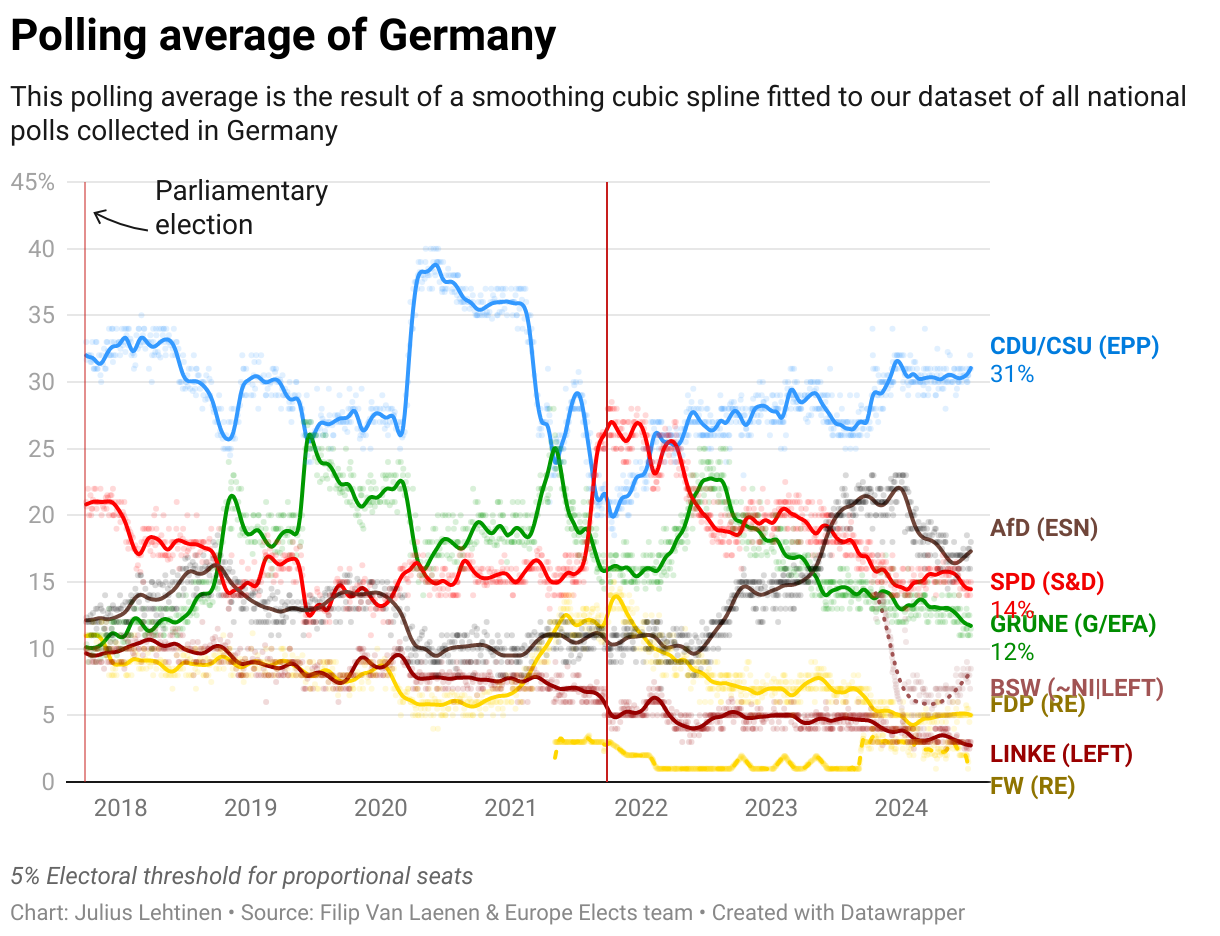
However, the downstream effects of such an argument are immense. If the NPD was certainly too irrelevant to ban and the AfD was presumably too large for it, the Court would have to conclude that there was no suitable time or size for a party ban, rendering this constitutional instrument completely obsolete.
Three paths to a ban
A motion to ban the AfD must come from either the federal government, a majority in the Bundesrat — the second chamber of parliament, which is comprised of the country’s state governments — or by a resolution in the German parliament, the Bundestag.
A Bundestag resolution failed in the last legislative period, and another attempt is considered unlikely. Similarly, Chancellor Friedrich Merz (CDU-EPP) and Federal Interior Minister Alexander Dobrindt (CSU-EPP) have expressed doubts about the federal government proposing a ban.
There is some noise about the possibility of the last option, a simple majority vote in the Bundesrat. The state of Bremen is planning to propose a ban. However, it remains unclear whether there are enough federal states to support the motion, as without the backing of Merz’s Christian Democratic Union (CDU-EPP), no majorities are realistically possible.
The “three ways”, however, are only ways to initiate a ban procedure. The actual ban proceedings are being led by the Constitutional Court. The federal government, MPs, or the state governments then take on the role of the prosecution.
Legal arguments meet political concerns
Yet, assuming that a ban proposal actually gets made, the metric the Constitutional Court could use to justify a ban on the AfD remains murky. When it banned the far-left Communist Party of Germany (KPD) in 1956, the Constitutional Court made it clear that ‘aggressive combativeness’ against the constitution was a prerequisite for a ban. However, no detailed definition of what constitutes such behaviour was provided. In 2017, the court added that the ‘systematic pursuit of anti-constitutional goals’ was also sufficient grounds for a ban.
Is the AfD’s behaviour ‘aggressively combative’ or do the party’s policies constitute a ‘systematic pursuit’ to overthrow the constitution and its institutions? The AfD has demonstrably sought to establish a new norm that would disadvantage German citizens with dual citizenship, for example, in terms of receiving social benefits. This would clearly be unconstitutional. But would that be enough?
What would be the impact of banning the AfD?
The only successful party bans in Germany to date have been that of the far-left Communist Party of Germany (KPD) in 1956 and the neo-nazi Socialist Reich Party (SRP) in 1952. Nevertheless, they provide a glimpse into what the immediate consequences of a ban might look like.
First and foremost, the party would cease to exist formally. It would not be allowed to participate in elections, and the establishment of successor organisations would be punishable by law. While not an automatic consequence, its financial resources would almost surely dry up.
All AfD seats in the federal and state parliaments would be immediately terminated, and employees of AfD members of parliament would lose their jobs. The parliamentary seats would not be replaced. The current Bundestag would suddenly have only 472 members, with completely new majority ratios. The symbols of the AfD would also be illegal if the party were banned — similar to how German law treats Nazi iconography. Every sticker be