
Recent changes to our social media charts have sparked a lively debate online about whether they were an improvement. We think they were. Here’s why, and here’s how to read the new design.
How the old charts worked
The old design had one real strength: it was simple.

Every party got a single label below its bar: the abbreviation of a European Parliament group. Because EP groups are organised along ideological lines, that label quietly told readers roughly where a party stood. That was the point. It gave readers a sense of ideology without us having to sort parties into ideological categories, which rarely translate well across borders, and it told a European story about national polls and elections.
The catch is that many parties have no MEPs. To fill that gap, we translated other international ties into an EP group: membership of a europarty, a group in the Parliamentary Assembly of the Council of Europe (PACE), cooperation in the Nordic Council, or even a cooperation agreement with a single foreign party. Because these networks largely overlap, the result usually gave a fair indication of a party’s orientation.
Usually, but not always.
Where it broke down
The problem grew once Europe Elects began covering European countries outside the EU.
The Swiss People’s Party (SVP) was shown as RE (because it sits in the ALDE group at PACE, linked to the ALDE europarty, which sits with the Renew European Parliament group), even though Switzerland elects no MEPs. The SVP is also a national-conservative party with a clearly anti-liberal profile, so the chain “ALDE at PACE, therefore RE, therefore liberal” was misleading.
Later, following our own guidelines, we added ESN and PfE to the SVP’s bar because of documented contacts with parties in those families. The SVP had met with the AfD on a few occasions, for example, and on that basis we added ESN.
It was messy, and other cases were worse. Turkish parties appeared as S&D, a group they cannot belong to because Türkiye is not in the EU and elects no MEPs. United Russia appeared as EPP|PfE, partly because of a cooperation agreement with New Democracy from the 2010s that it had never publicly renounced.
Try explaining that logic to a new reader in one sentence. We want to embrace new students of European politics, not scare them with explanations like the ones above.
Over the years, EP groups and europarties occasionally wrote to us to question this approach, and they had a point. The system was internally consistent, but it could mislead.
So why did we keep it for so long?
The system wasn’t perfect, but it did the job, mostly.
Our core audience was used to it, and we did not have the resources for a full redesign. Now we do. And we hope that our new system is inclusive enough to engage novices to European politics and Europe Elects die-hards alike.
What has changed
Our new charts fix this in four ways. Let’s have a look.
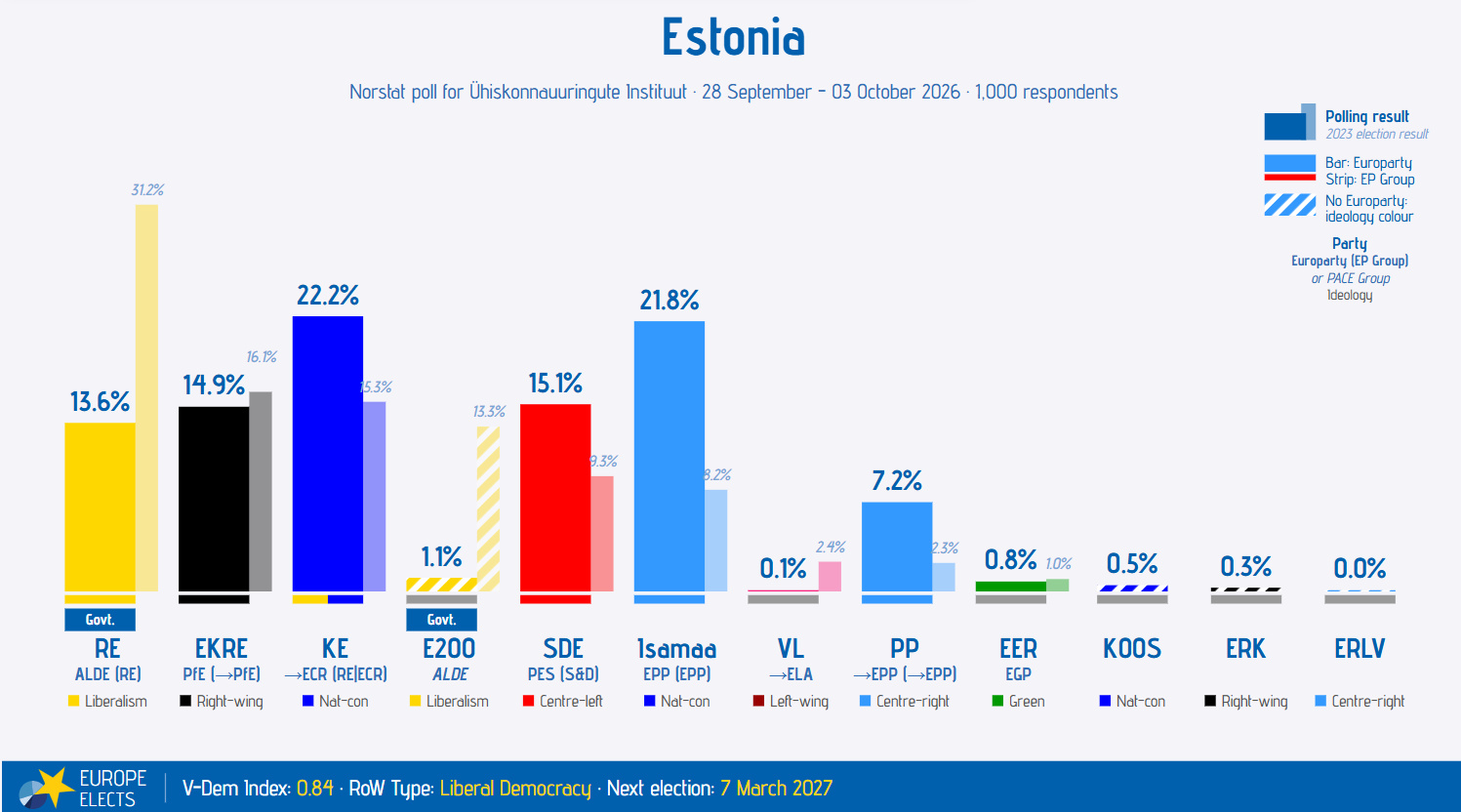
- Each label means exactly one thing as a europarty is shown only if the party is a member of it and an EP group only if its MEPs sit in it, with nothing inferred from a neighbouring organisation.
- “None” is shown as none. A party without a europarty or group gets a blank or * rather than the closest match. The SVP now shows no europarty and no group, with its ideology, National conservatism, underneath.
- Members, applicants and outsiders look different, with full members labelled plainly, while parties that have applied to join get an arrow (→), and PACE groups appear only in italics, so a Council of Europe group is distinguished from an EU one.
- Parties outside the EU are described on their own terms. This means that for countries without MEPs, such as Switzerland, Türkiye, Iceland, or the Western Balkans, the chart shows the ties they do have, through europarties and PACE, and their ideology. It no longer squeezes them into a group in a parliament they do not sit in.
Reading a bar
The colours answer two separate questions: the bar shows the europarty, the strip underneath shows the EP group.
- Solid bar = europarty. PES red, EPP light blue, ALDE yellow, EGP green, and so on.
- Striped bar = no europarty. The stripes take the colour of the party’s ideology, so a centrist party outside any europarty is striped orange.
- Split bar = two europarties. A party that belongs to two, such as PAN in Portugal (Animal Politics EU and EGP), gets a bar in two halves.
- Strip under the bar = EP group. One colour per group. A party whose MEPs sit in two groups, such as KE in Estonia (RE and ECR), gets a two-colour strip. Grey means no group.
- Alliances and joint lists show each member’s colour as its own segment.
- Pale bar beside it = last election result, with its figure above, in a lighter shade of the same colour.
Reading the labels
Under each party name, the chart prints Europarty (European Parliament or EP group), then the ideology:
| The party is… | Label |
|---|---|
| In the EPP europarty, MEPs in the EPP group | EPP (EPP) |
| In no europarty, MEPs in Renew Europe | * (RE) |
| In the Patriots europarty and group | PfE (PfE) |
| In no europarty, but applying to join ECR | →ECR |
| In two europarties | AnimalEU|EGP |
| In neither, but in the ALDE group at PACE | ALDE (italic) |
An asterisk means “none”, and an arrow means the party has applied or announced its intention to join. The PACE group appears only as a last resort, and in italics, so it is never mistaken for a europarty. Alliance affiliations are derived from the affiliations of their member parties.
Some names are shortened for space: Patriots.eu becomes PfE, Greens/EFA becomes G/EFA, Animal Politics EU becomes AnimalEU, European Pirate Party becomes PPEU.
Ideology line. Each party’s broad ideology, with a coloured square in that ideology’s colour. An alliance shows its own orientation. If its members share one ideological label, it takes that label. When they differ, it is shown as Diverse left or Diverse right if all members’ labels sit on that side.
| Category | Left | Right |
|---|---|---|
| Ideology | Centre-left, Left-wing, Far-left, Eco-socialism | Centre-right, Right-wing, Far-right, National conservatism |
| Europarty | PES, PEL, ELA, ECA, DiEM25 | EPP, ECR, PfE, ESN, ECPP |
| EP group | LEFT, G/EFA, S&D | EPP, ECR, PfE, ESN |
Labels outside these lists, such as Green politics or Regionalism, don’t place an alliance on either side by themselves. An alliance containing them is still shown as Diverse left or Diverse right if at least one member is on that side, none is on the other, and its members’ European Parliament groups and Europarties point the same ideological direction without contradiction. Any other combination, including missing affiliation data, is shown simply as Diverse. We use this cautious approach so that an alliance is never given a direction its members don’t support, even if that sometimes makes a label less specific than it could be.
On busy charts with many parties, long ideology names are shortened: National conservatism → Nat-con, Christian fundamentalism → Christ. fund., Regionalism → Region., Agrarianism → Agrarian.
How do we define our 18 ideological labels? Find out at the bottom of our country pages, for instance, here: https://europeelects.eu/germany.
Candidate elections
In presidential, mayoral and government elections, each bar is a person. Under the candidate’s name, the chart adds their national party, then the same europarty, EP group, and ideology lines as for parties. The legend switches from “Party” to “Candidate / National party”.
The affiliations shown are those of the candidate’s party. In the Fribourg government election, for example, Castella appears as PLR, then ALDE, then Liberalism. Independents are marked “Ind.”.
| What | Meaning | Where you see it |
|---|---|---|
| Europarty | The pan-European party it is a member of, such as EPP, PES or ALDE | Bar colour; first part of the label |
| European Parliament group | The group its MEPs sit in, such as RE or S&D | Strip under the bar; in brackets in the label |
| PACE group | Its group in the Parliamentary Assembly of the Council of Europe | In italics in the label, only when it has neither of the above |
| Ideology | Its broad political orientation, such as Centre-right or Green politics | Line under the label, with a coloured square |
All affiliations come from the Europe Elects party database and show formal memberships as they stand today. They are not our seat projections: a party we expect to sit with Renew but whose MEPs are non-attached shows no group. When a party joins or leaves a europarty or group, our charts follow.
The post text
The text posted with each chart names europarties only. A party outside any europarty gets “*”.
| Case | Post text |
|---|---|
| Party in a europarty | PSD-PES: 30.0% |
| No europarty | POT-*: 2.0% |
| Intends to join | KE→ECR: 15.0% |
| Two europarties | PAN-AnimalEU|EGP: 1.4% |
| Candidate | Castella (PLR) (ALDE): 20.0% |
| Candidate, no europarty | Abdulle (DAS/WAS) (*): 20.0% |
| Independent candidate | Courtet (Ind.) (*): 48.9% |
Figures in the table are examples. Neither EP groups nor PACE groups appear in the text, and names are shortened the same way as on the chart.
We chose Europarties because they are the membership a party chooses for itself across Europe. EP groups and PACE groups are groups in parliamentary assemblies, and many parties, including most outside the EU, belong to none.
We will also continue to improve our social media design incrementally. We appreciate the constructive feedback we have received along the way as we work to strengthen this design.
